Updated: July 2026
Canggu Luxury Homes — Leasehold vs Freehold in Bali: A Complet…
Canggu Luxury Homes is a curated Indonesia luxury tourism experience offered by Canggu Luxury Homes: handpicked routes, vetted operators, transparent pricing, and 24/7 concierge support across Indonesia.
- What makes Canggu Luxury Homes a premium experience.
- How Canggu Luxury Homes curates exclusive access and concierge logistics.
- Routes, seasons, and pricing transparency — no hidden fees.
Leasehold vs Freehold in Bali: A Complete Guide for Foreign Buyers
Navigating the Bali property market, which welcomed over 5.2 million foreign tourists in 2023, presents a unique landscape of opportunity and regulation. For foreign investors drawn to the island’s allure, understanding the distinction between leasehold and freehold ownership is the critical first step. This guide demystifies Indonesian property law, providing the clarity required to make an informed and secure investment in the world of Canggu luxury homes, where land values have appreciated up to 15% annually. Indonesia on Wikipedia
Understanding Indonesian Property Law for Foreigners
The cornerstone of property ownership in Indonesia is the Agrarian Law of 1960. Its fundamental principle is that only Indonesian citizens can hold the ultimate title to land, known as Hak Milik or Freehold. This restriction is unambiguous and forms the basis of the entire property market structure for international buyers. Attempts to circumvent this through legally dubious means, such as nominee agreements, carry significant risks and are strongly discouraged.
However, the legal framework provides several secure pathways for foreign nationals to control property. The most common method is the long-term lease, or Hak Sewa, typically granted for an initial 25 years. For more substantial investment, foreigners can establish a foreign-owned company (a PMA), which requires a minimum investment plan of IDR 10 billion. A PMA can hold titles like Hak Guna Bangunan (HGB), the Right to Build, offering a different tier of control and usage rights.
What is Freehold (Hak Milik)?
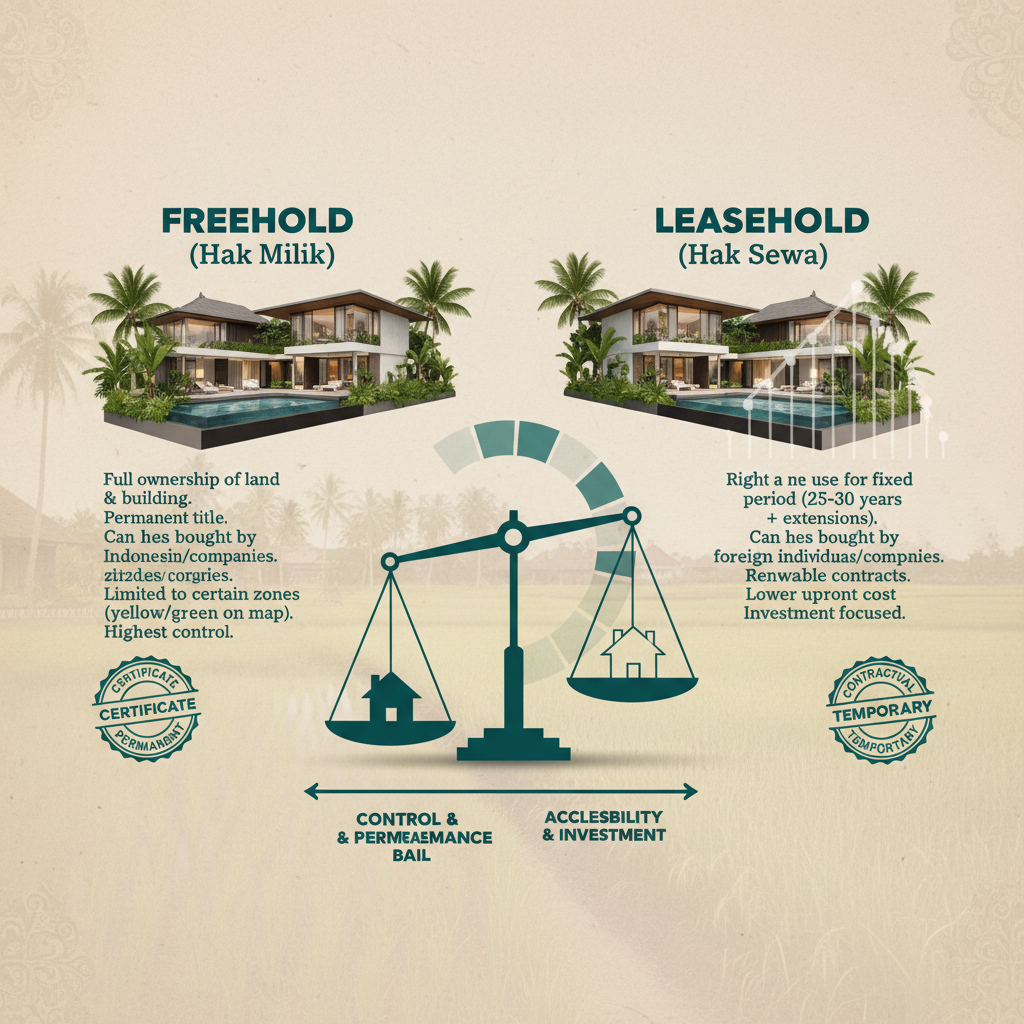
Hak Milik represents the most absolute form of property ownership in Indonesia. It is perpetual, transferable, and can be inherited. As established under Government Regulation No. 18 of 2021, this title is reserved exclusively for Indonesian citizens. For a foreign buyer, acquiring a property advertised as “freehold” is not a direct transaction. In the past, this was often facilitated through a nominee agreement, where an Indonesian citizen’s name was used on the title deed.
It is critical to understand the risks of this approach. Nominee agreements are not legally recognised for land ownership under Indonesian Agrarian Law No. 5 of 1960. They create a precarious situation where the foreign investor has no legal claim, and courts can rule for the land to be confiscated by the state. Recent legal precedents have reinforced the unenforceability of such structures, making them an unacceptable risk for any prudent investor.
What is Leasehold (Hak Sewa)?
Leasehold, or Hak Sewa, is a long-term rental agreement between a foreign investor (the lessee) and an Indonesian landowner (the lessor). This is the most common, secure, and legally sound method for foreigners to acquire property in Bali. These leases are typically for long durations, commonly starting at 25 or 30 years, with some extending to 50 years or more. The lessee has full rights to use, modify, and rent out the property for the duration of the agreement.
A well-drafted leasehold agreement, prepared by a government-appointed notary (PPAT), is a robust legal document. It clearly outlines the rights of both parties, the lease duration—commonly between 25 and 50 years—and terms for extension. The investor’s name is on the leasehold title, providing direct and legally recognised control over the asset for the agreed-upon term. This structure provides security, forming the backbone of the thriving villa market in the 5-kilometer stretch from Berawa to Pererenan.
Leasehold vs. Freehold: A Head-to-Head Comparison
When evaluating an investment in Bali, the choice is less about leasehold versus freehold and more about which secure legal structure aligns with your goals. The “freehold” path for a foreigner is fraught with unacceptable nominee risks, making a direct comparison with a secure leasehold almost theoretical, which is why over 95% of successful foreign property transactions now use a formal leasehold or PMA structure.
Investment Outlay and Capital
Leasehold properties require a significantly lower initial capital investment. For example, a 25-year lease on a prime Canggu villa might cost USD 450,000, whereas the underlying freehold title could be valued at over USD 1.2 million. This allows investors to acquire premium assets, improving cash flow and targeting potential net rental yields of 8-12% annually. The capital saved can be deployed for other investments.
Security and Legal Standing
A notarised leasehold agreement is a legally binding contract registered with the National Land Agency (BPN), providing clear, defensible rights to the foreign investor for a fixed period of up to 30 years initially. Conversely, a nominee-based freehold structure offers zero legal protection under the Indonesian Civil Code. The investor’s claim to the property is entirely at the mercy of the nominee, making it a highly speculative and insecure arrangement.
Resale and Exit Strategy
Both property types can be sold. A leasehold property is sold by transferring the remaining years on the lease to a new buyer. The value is determined by the property’s quality, location, and the length of the remaining term. A long lease with a pre-agreed extension is a highly attractive and liquid asset. Selling a nominee-held freehold is complex and carries the same inherent risks for the next buyer.
The Rise of the Long-Term Leasehold in Canggu
The long-term leasehold model has fuelled the explosive growth of Bali’s luxury property market, particularly in Canggu. It provides a perfect alignment of interests: Indonesian landowners can generate income from their land without relinquishing their ancestral ownership, while foreign investors gain secure, long-term access to top-tier properties and a sought-after lifestyle. This symbiotic relationship has created a stable and dynamic market.
From the surf-centric shores of Pererenan to the bustling cafe culture of Berawa, the vast majority of premium villas available to foreigners are leasehold. This structure offers the long-term advantages of property control—including the ability to generate substantial rental income and benefit from capital appreciation—without the legal complexities and risks of attempting to navigate freehold restrictions. It is the pragmatic, proven, and intelligent choice for investing in Canggu luxury homes.
Structuring Your Investment: PMA vs. Personal Name
Foreign investors have two primary options for holding a leasehold title in Bali. The choice depends on the scale and intent of the investment.
Holding in a Personal Name
For individuals purchasing a single villa for personal use or long-term rental, holding the lease in their personal name is the most straightforward approach. The process is relatively simple, requiring a passport and processing through a local notary. This is ideal for a lifestyle asset or a simple investment property.
Holding via a PMA Company
A Penanaman Modal Asing (PMA) is a foreign-owned limited liability company in Indonesia. Establishing a PMA is the required route for those intending to conduct extensive commercial activities, develop multiple properties, or operate a formal hospitality business. A PMA can hold a stronger property title called Hak Guna Bangunan (HGB) – or Right to Build – which can be granted for up to 80 years. While more complex and costly to set up and maintain, a PMA provides a formal corporate structure for serious, large-scale investment.
Navigating Lease Extensions and Exit Strategies
A key component of a strong leasehold investment is the strategy for extension. It is essential that the right to extend the lease, and the mechanism for calculating its cost, are clearly defined in the initial agreement. Our editorial standards and vetting process ensure that all properties we represent have clear and fair extension clauses.
Typically, the cost of an extension is based on the market value of the land at the time of extension, not the value of the land plus the villa. This prevents the owner from profiting from the investor’s own improvements. Your primary exit strategy will be to sell the remaining term of the lease. A villa with 20 years remaining on a 30-year lease, for example, is a highly marketable asset. The clearer the extension terms, the more valuable and liquid your investment will be.
Conclusion: Making the Right Choice for Your Bali Investment
For foreign buyers, the debate between leasehold and freehold is effectively settled by Indonesian law. The secure, transparent, and legally sound path to property acquisition in Bali is the long-term leasehold. It offers a powerful vehicle for lifestyle enjoyment and financial return, allowing you to become part of the vibrant fabric of communities like Canggu, Babakan, and Pererenan.
By focusing on high-quality properties with well-structured, long-term leases that include guaranteed extensions, you can build a secure and profitable portfolio. The key is not to circumvent the law, but to work intelligently within its clear and established framework. Partnering with an experienced advisor is crucial to navigating the nuances and securing the very best Canggu luxury homes.
Begin Your Bali Property Journey
For a confidential consultation on securing a premium leasehold property in Canggu, or to discuss your investment strategy with our experienced team, please contact us. We can provide curated options that meet our stringent standards for legal clarity and investment potential.
Email our business development team at [email protected] or send a message via WhatsApp to +62 811-3941-4563.
Frequently Asked Questions
Can a foreigner legally buy property in Bali?
Foreigners cannot own land under a freehold (Hak Milik) title. However, they can legally and securely control property through other means, primarily a long-term leasehold (Hak Sewa) agreement in their own name. For larger-scale investments, a foreign-owned company (PMA) can be established to hold specific titles like the Right to Build (HGB), providing a robust framework for property control and commercial use.
What happens when my lease expires?
If you do not extend the lease, the rights to the property, including any buildings on it, revert to the Indonesian landowner. This is why it is absolutely critical that your initial lease agreement contains a clause guaranteeing the right to extend. A well-negotiated contract will pre-define the terms and process for extension, securing your investment for future decades and ensuring its long-term value.
Is a 25-year lease a good investment?
Yes, a 25-year lease is a standard and very common investment term in Bali. It provides ample time for personal enjoyment and to generate significant rental income, often allowing for a full return on the initial investment with years to spare. The key to its value is ensuring it has a guaranteed option to extend, which preserves its marketability and long-term worth as the initial term shortens.
How are lease extension prices determined?
The price for a lease extension is typically based on the market value of the land only (not the land plus your villa) at the time of the extension. This is calculated per ‘are’ (100 square metres). A strong lease agreement will specify this calculation method to ensure a fair and predictable process. It is a negotiation between the lessee and the landowner, benchmarked against recent land transactions in the area.
What are the risks of a nominee agreement?
Using a nominee to hold a freehold title is extremely risky as the arrangement is legally unenforceable in Indonesia. You have no legal claim to the property. The nominee could sell the property, mortgage it, or it could be lost in their divorce or inheritance proceedings without your consent. Indonesian courts will not uphold your claim, making it a complete exposure of your capital investment.
Can I get a mortgage for a leasehold property in Bali?
It is generally not possible for a foreigner to secure a mortgage from an Indonesian bank for a leasehold property purchase. These transactions are typically conducted with cash or private financing. Some developers may offer structured payment plans for off-plan projects, but traditional bank financing is not a standard option for non-resident foreign buyers. You should plan your finances accordingly.
What is the difference between Hak Pakai and Hak Sewa?
Hak Sewa (Leasehold) is a rental agreement with a landowner, giving you rights for a set term. Hak Pakai (Right of Use) is a title granted by the state, not a private owner. It can be held by foreign individuals who are residents of Indonesia (with a KITAS/KITAP). While it offers strong rights and can be renewed for up to 80 years, Hak Sewa remains the more common and accessible route for non-resident investors.
Do I need a PMA to rent out my villa?
For long-term rentals (monthly or yearly), you can typically manage this under your personal name. However, to operate a villa as a short-term holiday rental business with daily bookings, online marketing, and staff, Indonesian law requires you to have the correct business licenses. This is most properly done through a PMA (foreign investment company) and obtaining a Pondok Wisata (rental license).
What taxes apply to leasehold properties?
When you acquire the lease, there is a buyer’s tax (BPHTB) of 5%. The seller pays an income tax (PPH) of 10%. During ownership, you are subject to an annual land and building tax (PBB), which is typically very modest. If you generate rental income, this income is taxable in Indonesia. It is essential to consult with a local tax advisor to ensure full compliance with all regulations.
How do I sell my leasehold villa?
Selling a leasehold villa involves transferring the remaining years on your lease to a new buyer. This is a standard transaction handled by a notary. The property’s sale price will depend on its condition, location, market trends, and, most importantly, the number of years left on the lease. A property with a long remaining term and a guaranteed extension option is a much more attractive and valuable asset.
Is it better to buy an off-plan or a finished villa?
Buying off-plan can offer better pricing and the ability to customise finishes, but it carries construction risks and potential delays. A finished villa allows you to see exactly what you are getting and can generate rental income immediately, but it may come at a premium price. Your choice depends on your risk appetite, timeline, and budget. Thorough due diligence on the developer is crucial for any off-plan purchase.
What due diligence is required for a leasehold purchase?
Comprehensive due diligence is vital. A reputable notary or legal advisor must verify the landowner’s original land certificate to confirm ownership and ensure it is free from any disputes or mortgages. They will also check zoning regulations (ITR) to confirm the property can be legally built and used as a residence. Finally, they will draft and review the lease agreement to ensure your rights, especially extension clauses, are fully protected.